
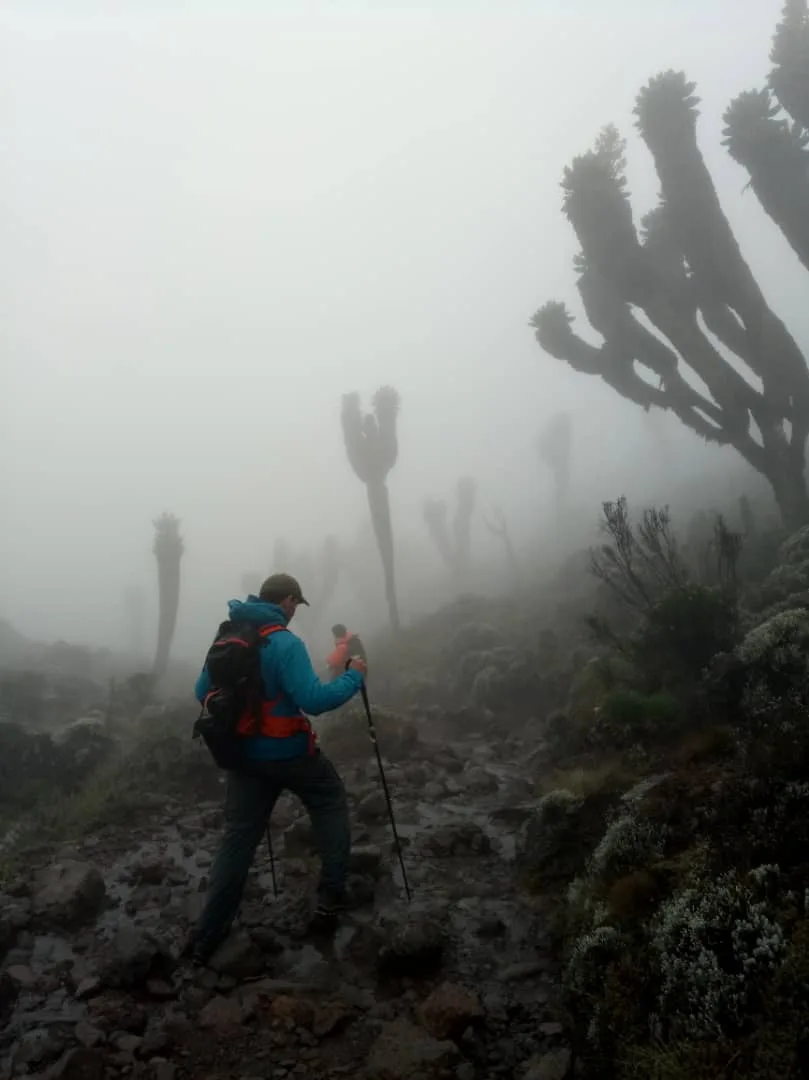
Each group has a lead (chief) guide as well as assistant guides, a cook and porters. All of our guides are licensed mountain guides with Wilderness First Responder or First Aid training (trained by Wilderness Medical Associates). Your porters carry all of your gear, tents, sleeping bags, mattresses, food, water, cookware, gas, stoves, medical supplies, chairs and tables — and arrive at each camp long before you to prepare for your arrival. Their strength, skill, stamina and grace are legendary.
Kilimanjaro FAQ
Frequently Asked Questions
Everything first-time climbers ask — guides, routes, fitness, accommodation, water, altitude, weather, the sun, tipping and certificates.
Guides, porters & crew
You will not carry your main gear up the mountain. Your porters (your guardian angels) can carry approximately 30 lbs (15 kg) of your gear each; the rest can be stored safely at the hotel. You only carry a daypack with the essential, personal items you need with you at all times — see the packing list we provide.
Choosing your climb
There are several established routes to climb Kilimanjaro, each with its own character. The Marangu ('Coca-Cola') route is the classic and the only one with huts. The Machame ('Whiskey') route is very popular and scenic, but can be busy. The Lemosho, Shira and Rongai routes are quieter and, taken over 6–8 days, give better acclimatisation and a higher chance of reaching the summit. The Umbwe route is the shortest, most direct and toughest — and the least popular. We'll help you match the route to your dates and fitness.
The Rongai, Lemosho, Shira, Umbwe and Machame routes are camping routes that take longer and are considered more scenic. On the Marangu route you stay in huts rather than tents, and you hike up and down the same path. The Rongai route climbs the north side and descends via Marangu; the Lemosho, Shira and Machame routes traverse the mountain and descend via the Mweka route.
It certainly helps! You don't need to be marathon-fit, but if you arrive out of shape or without training you won't enjoy the trek as much — and your fitness affects the whole group's strength. Train by hiking or jogging with a pack on your back to build stamina and condition your feet, boots, joints and muscles. A couple of months of treadmill or elliptical cardio beforehand makes a big difference. You will not regret putting in the work before your climb.
On the mountain
On the Marangu route, trekkers stay in A-frame huts, each with a dining room and separate bathroom facilities (flush toilets or pit latrines); there is no electricity. On all other routes you camp the whole way, with shared pit latrines. On every route you are given a bowl of hot water each day to 'wash up'.
On the first day you bring your own water; beyond that, water is provided on all routes. It is taken from fresh mountain streams, then boiled and treated to make it safe to drink. We recommend at least 3 litres a day — staying hydrated significantly increases your chances of staying healthy as you ascend.
The highest point is Uhuru Peak at 5,895 metres (19,341 feet) — the summit of Kilimanjaro and the highest point in Africa.
Absolutely, so precautions are essential. About 55% of the earth's protective atmosphere is below 5,000 m, so far less ultraviolet light is filtered out and the sun's rays are much stronger. Use SPF 20+ sun cream at lower altitudes and a total block above 3,000 m. Wear dark sunglasses (ideally with side panels) above 4,000 m — they are essential on snow or ice, where snow blindness can be very painful and may require your eyes to be bandaged for at least 24 hours.
Weather & when to climb
It depends on the season — and remember the weather on a high mountain can change very quickly. Below is a guide to each part of the year.
Generally warm and dry after the short rains, and away from the high season so relatively quiet. Dry and quiet — one of our favourite times to climb.
The long rainy season, although it has become more unpredictable in recent years. If you don't mind rain you can have the mountain almost to yourself, and you can nearly always get a good discount. Long rainy season.
The driest months, but August to October is very busy. The shoulder months of June, July and early November are good compromises if a little rain doesn't deter you. Dry but busy.
The short rains usually start towards the end of November and last 3–4 weeks. Rain is generally less persistent than in the main rains, so this is a good time to be on the mountain without the crowds. Short rainy season.
Health & altitude
At altitude there is less oxygen, and the body needs time to adapt. Most climbers experience at least mild Acute Mountain Sickness (AMS), caused by the body failing to adjust quickly enough to the reduced oxygen. The most common symptoms are headaches, light-headedness, nausea, loss of appetite, tingling in the fingers and toes, and mild swelling of the ankles and fingers. These mild forms are not serious and normally disappear within 48 hours. Your physician can advise whether preventative medication is right for you.
Above about 3,500 m the reduced oxygen and air pressure can cause unpleasant changes; the most common complaint is AMS (headache, nausea, vomiting, diarrhoea, loss of appetite, fatigue and insomnia). Some climbers use Diamox (acetazolamide) to aid acclimatisation — it is a prescription sulfa drug, so consult your physician before use and always tell your guides if you are taking it. Other useful items include anti-diarrhoea medication, painkillers, rehydration salts, sunblock and malaria pills. Diamox is not a 'miracle drug' and does not guarantee prevention, but it can help.
Edema (a build-up of fluid in the body) is caused by ascending too fast without allowing the body to acclimatise. There are two dangerous forms at high altitude: High Altitude Cerebral Edema (HACE) and High Altitude Pulmonary Edema (HAPE). There is no medication to prevent or cure edema — the only prevention is a slow approach to altitude, and prompt descent 'cures' the sufferer. Returning to altitude after edema causes a relapse and is not advised under any circumstances.
Listen to and communicate well with your guides — they know life on the mountain. Stay hydrated (at least 3 litres a day, sometimes 5–6). Avoid tobacco, alcohol and depressants such as sleeping pills. 'Don't go up until symptoms go down,' and tell your guides if you feel ill. Rest well before your trip, take your time (pole pole — go slowly), and where possible walk high and sleep low. Six factors affect altitude illness: rate of ascent, altitude attained, length of exposure, level of exertion, hydration and diet, and your own physiology.
Hypothermia is when the body's deep-core temperature drops below 35°C (95°F), caused by prolonged exposure to cold without adequate clothing. Danger signs include drowsiness, very cold skin on normally covered areas (stomach, armpits), slurred or incoherent speech, and an absence of complaint about feeling cold even in a bitterly cold environment. Proper layering and warm summit-night gear prevent it, and your guides monitor everyone closely.
Tipping & your certificate
Tipping is an expected and highly appreciated part of your trek and an important source of income for your crew. It usually works out to around US $200–$275 per climber in total, given at a tipping ceremony once everyone and all gear are safely down the mountain. Tips are best placed in a group envelope and handed to the lead guide. As a per-day, per-group guideline: chief guide ~US $25, assistant guide ~US $15, cook ~US $15 and porter ~US $10. These are guidelines only — adjust for a particularly hard trek or outstanding service. Quality warm clothing or footwear in good condition also makes a welcome gift.
On successful completion you return to the main park gate where you began, 'sign out' from the mountain trails, and receive an official certificate with your name, the date of your climb and signatures from your head guide — a gold certificate for those who reached Uhuru Peak.
Still have a question?
If your question isn't answered here, just ask — we love to talk to travellers and will reply with honest, local advice.